Where a door actually fails
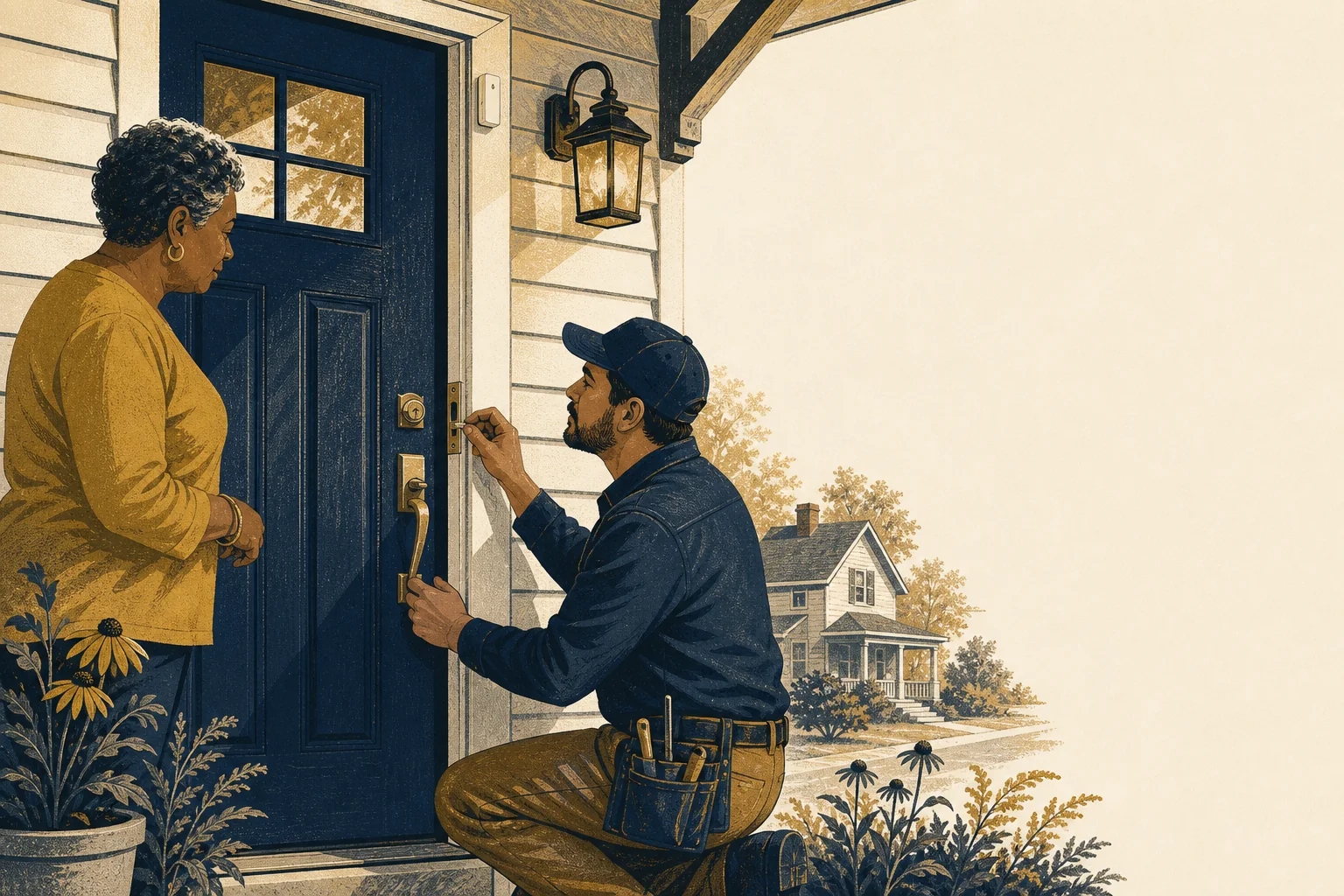
When a door is kicked, the deadbolt usually holds. What fails is the door frame: the bolt sits in a small metal plate — the strike plate — fastened to the soft pine of the frame with two or four screws about three-quarters of an inch long. The kick splits the pine and the whole plate, bolt still extended, comes away with it. The lock was fine. The frame was never asked to hold.
The six-dollar fix
Replace the strike-plate screws with 3-inch screws. That length passes through the frame and into the wall stud behind it, so a kick has to break the house, not the trim. Do the same for the hinge screws — at least one per hinge, and all of them if you are there anyway. Better still, replace the small strike plate with a heavy-duty strike plate (long, with four to six screw holes) for another ten dollars. Do every exterior door: front, back, side, and the door from the garage into the house, which is the one people forget and burglars do not.
That is the whole upgrade. Long screws, heavy strike, every exterior door. We do it as standard on every install and we would rather you did it yourself this weekend than wait for us.
The deadbolt
Every exterior door should have a proper deadbolt in addition to the knob lock, with a bolt that extends a full inch into the frame. Deadbolts carry a grade — ANSI/BHMA Grade 1 is the strongest, Grade 2 is good, Grade 3 is builder-basic — and the grade is printed on the box. Grade 1 or 2 from a reputable maker is worth the modest difference. If a door has a window within arm's reach of the lock, a burglar breaks the glass and turns the thumb-turn; either move to a lock without a reachable thumb-turn or, more simply, apply security film to that glass.
And use it. An astonishing share of “break-ins” are walk-ins through unlocked doors. The habit is free.
The door itself
A hollow-core interior door hung as an exterior door — it happens — will not hold anything. Exterior doors should be solid wood, fiberglass or steel. Where an existing door is weak, a door reinforcement kit (a steel wrap for the lock area and a long strike) is far cheaper than a new door and works well.
Sliding doors and windows
- Sliding glass doors lift out of their track or are pried at the latch. A dowel or bar in the bottom track and a pair of screws in the top track (so the door cannot be lifted) defeat both. Auxiliary locks that pin the door to the frame are inexpensive.
- Windows at ground level need working locks and, on the ones hidden from the street, either a pin or a secondary lock. Window and door sensors, tied to a siren or a phone alert, are what makes a window that is broken into a short visit rather than a long one.
Light
The cheapest deterrent there is. Motion-activated fixtures at every entrance and along the drive; a dusk-to-dawn light at the front. Burglars are looking for the house where they will not be seen. Be the other house.
Where smart locks fit
A smart deadbolt does two things a key cannot: it tells you whether the door is locked (and locks it for you at night), and it gives each person their own code, so you can let a contractor in on Tuesday only and know when your teenager actually came home. Buy one from an established lock maker with a real ANSI grade — the lock part still has to be a lock — and prefer one that works locally (Z‑Wave, Zigbee, Thread or Matter) rather than only through a company's app, so it keeps working when the internet or the company does not. Our home systems service builds these into a household's Home Assistant system; the strike-plate screws still come first.
Want it done for you? Reinforced strike plates on every exterior door are standard in every security installation we do — and we will happily do the six-dollar version alone during a household checkup in person.